
I Built the Platform I Have Been Writing About. MOC Fiduciary Intelligence Is Live.
By Jude Odu
Sept. 10, 2026
For years I have written some version of the same paragraph on this blog. Your plan is bleeding money. The law already gives you the authority to find it. Here is the framework, here is the report logic, here is the question to put to your TPA.
Then the post ends and you go back to your desk, and the work is still yours.
That changed on September 8. MOC Fiduciary Intelligence (MOC-FI), is live at fiduciaryIQ.ai.
The gap this closes
A book hands you a method. A consultant hands you a scope and an invoice. Neither one hands you an answer on a Tuesday afternoon.
That gap is where most plan sponsors operate. You already know the fiduciary duty is real, you have watched the complaints filed against Johnson and Johnson and Wells Fargo move through the courts, and you have a working suspicion that your own fee disclosure file is thinner than it should be. What you do not have is a way to find out this week, without a procurement cycle, without a six-figure engagement, and without asking the vendor you are trying to evaluate to grade its own homework.
Now you do.
What it actually does
You load your plan’s own record. The ASO or TPA agreement and every amendment. The PBM contract. The stop-loss policy. The broker compensation disclosure. The Form 5500. The gag clause attestation. De-identified medical and pharmacy claims data.
MOC-FI reads all of it and scores your plan on 32 fiduciary indicators, each one mapped to a duty under ERISA or an obligation under the Consolidated Appropriations Act, including the 2021 and 2026 fee disclosure rules, weighted by the five Model Optimal Care principles that hold the framework together: Transparency, Accountability, Integration, Engagement, and Technology Enablement.
Three things come back. A comprehensive fiduciary report. An MOC Fiduciary Score on a scale from 1 to 10. A citation to the exact provision in your plan documents behind every finding.
That third one matters more than the score. A number you cannot trace is an opinion. A number you can trace to Section 9.3 of your own administrative services agreement is a finding you can carry into your next committee meeting and defend.
Evidence, not a questionnaire
Most fiduciary assessments ask what you believe is true about your plan, you answer from memory or from what your broker told you last spring, and the tool grades your recollection back to you as though it were a measurement.
MOC-FI reviews the record instead.
It scores each indicator against the language and the numbers it finds in your own documents, and the questionnaire covers only what those documents leave unanswered. The difference shows up inside ten minutes. Sponsors are routinely confident their audit rights are adequate, right up to the moment the platform quotes them the clause capping those rights at one audit per contract year with 60 days written notice.
It reviews 100 percent of the claims data you upload. Not a sample. In one comprehensive review of a sample plan, MOC-FI identified $5.23 million in savings opportunity, with $1.24 million recoverable immediately.
Built for this community, not adapted for it
MOC-FI was conceived, designed, and built from the ground up for the self-funded community. It is not a repackaging of an existing platform or technology, it is not a general purpose chat assistant wearing a healthcare label, and it is not a payment integrity engine sold under a new name. The data model, the indicator set, the scoring math, and the report were written on a blank slate for one reader, the person accountable for the self-funded plan.
That distinction is not a marketing line. It shows up in what the platform knows to look for.
For example, a general tool does not know that a base agreement without its fee schedule has left out the pricing. It does not know that amendments are where fees get added and performance guarantees get quietly softened. It does not know to check whether the gag clause attestation you filed actually matches the contracts you signed. Those are not clever features. They are the things a practitioner checks first, and they were built in because a practitioner specified them.
Four things the score alone does not tell you
First, MOC-FI handles ERISA and non-ERISA plans. Governmental and church plan sponsors are scored on the same framework, against the standards that actually govern them, a community every fiduciary tool I have examined over the years has left behind.
Second, it tracks state legislation across all 50 states. PBM regulation, mandate expansion, and transparency law now move faster than an annual compliance review can absorb, and the platform shows you where your self-funded, PBM, and fully insured arrangements are exposed as the rules change in your state.
Third, it tells you what to fix first. Every deficiency arrives with a prioritized recommendation and a sequence for working through it. A finding you cannot act on is just anxiety with a citation attached.
Fourth, it runs a whole book of business. Brokers, consultants, TPAs, and PEOs score every plan on the same standard, then rank the entire book by exposure in one unified portfolio view.
How your data is handled
MOC-FI ingests de-identified data only, under the HIPAA Safe Harbor standard. A PHI confirmation check guards every upload. Multi-factor authentication is required on every user account without exception, and every permission and data boundary is enforced on the server rather than hidden behind an interface that merely declines to show you the button.
Model Optimal Care is not a business associate and does not accept protected health information. The upload guide and the checklist name the exact fields to strip before you send anything. Read them first.
Why now
CMS projects that U.S. healthcare spending reached $5.7 trillion in 2025. Apply the 25 to 30 cents of every dollar that JAMA and subsequent extrapolations attribute to waste, and the number lands as high as $1.7 trillion a year. Set that figure beside national economies and American healthcare waste alone would rank sixteenth in the world, ahead of Turkey, Indonesia, and the Netherlands.
Those are not line items. Those are whole countries.
Self-funded plans cover close to 160 million Americans, roughly 67 percent of insured U.S. workers according to KFF, and a National Alliance of Healthcare Purchaser Coalitions survey found 65 percent of employers reporting growing concern about fiduciary litigation exposure. Elizabeth Mitchell, President and CEO of the Purchaser Business Group on Health, has put the obligation plainly: “Under the Consolidated Appropriations Act of 2021, employers are legally accountable as fiduciaries for their health plans, requiring them to provide employees with the best healthcare benefits for the best price.”
Plan sponsors hold that duty. They fund every claim. Most of them still cannot see what their plan is paying for.
I have spent more than 25 years watching that happen from the inside, at a commercial payer, at a hospital system, and across the self-funded plans I have worked with and studied since 2014. The framework has been in print since May. The platform went live on Tuesday.
Start this week
Three steps. None of them requires a call with me.
- Start the free trial at fiduciaryIQ.ai and create your plan record. It only takes a few minutes.
- Pull the eight starter documents the upload guide recommends. Most sponsors already have seven of them within arm’s reach.
- Run one comprehensive report before your next fiduciary committee meeting, and bring the report and the score into the room with you.
Every account includes a comprehensive User Guide and an in-product upload guide covering seven document categories and more than 60 document types. You can run your first report in one afternoon without requiring any training.
The offer
MOC-FI is free for one month. The trial includes one full comprehensive fiduciary report and score, not a preview, and it requires no credit card. If you never subscribe, the report is still yours to keep.
Review the features, the scoring methodology, and the fiduciary case: modeloptimalcare.com
Start your free month: fiduciaryIQ.ai
Every sponsor reading this faces the same two options I have watched plan after plan face for twenty-five years. Keep funding what you cannot see, and hope the next disclosure request goes to someone else. Or spend one afternoon finding out where the plan actually stands, while it still costs you nothing.
The month is free. The choice is yours.
About the author
Jude Odu is Founder and Principal of Model Optimal Care, LLC, a Phoenix, Arizona company building artificial intelligence and analytics solutions for self-funded health plans. He is the author of the bestselling book Model Optimal Care: End U.S. Healthcare Waste, One Health Plan at a Time (Manuscripts Press, May 2026), which debuted at No. 1 New Release in the Health Insurance category on Amazon. He has spent more than 25 years in healthcare technology and data science and previously founded Health Cost IQ and Health Data Intelligence. Learn more about the MOC framework, the CP-MOC certification program, and MOC Fiduciary Intelligence at modeloptimalcare.com.
Sources cited in the post
- CMS, for the $5.7 trillion 2025 national health expenditure projection. It is a projection, not final actuals.
- JAMA and subsequent extrapolations, for the 25 to 30 cents of every dollar attributed to waste.
- Worldometer and IMF 2025 GDP data, for the sixteenth-largest-economy comparison.
- KFF, for 67 percent of insured U.S. workers in self-funded arrangements.
- National Alliance of Healthcare Purchaser Coalitions, for the 65 percent fiduciary litigation concern figure.
- Elizabeth Mitchell, President and CEO, Purchaser Business Group on Health, quoted as previously published on this blog.
Stay Informed
Get The MOC Brief, the twice-weekly healthcare policy analysis for self-insured professionals and healthcare leaders committed to eliminating waste and optimizing care delivery.
About the author

Jude Odu
Founder of Health Cost IQ and author of Model Optimal Care. 25+ years in healthcare technology.
Learn more at judeodu.com
Categories
The Book
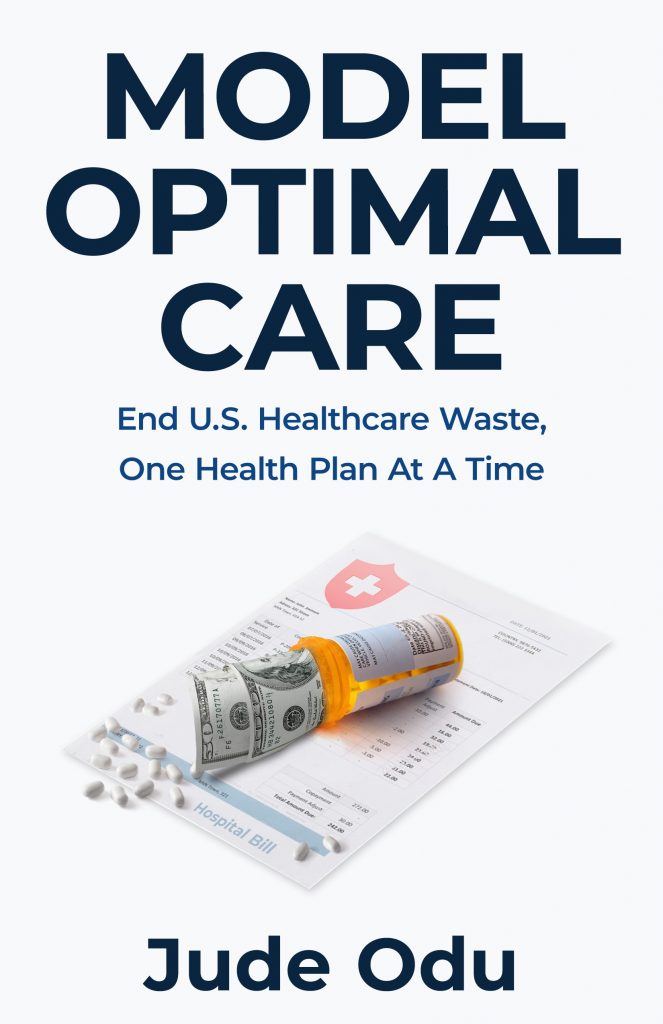
The definitive guide to ending U.S. healthcare waste. One health plan at a time.