Professional Certification Program

Model Optimal Care Academy

Professional education for the people who manage, advise, and optimize employer-sponsored health plans.

The CP-MOC Certification

Certified Professional in Model Optimal Care — the credential that proves your mastery of data-driven, fiduciary-grade health plan management.

CP-MOC

Certified Professional in
Model Optimal Care

What Is the CP-MOC?

The CP-MOC designation is a professional certification for individuals who demonstrate mastery of the Model Optimal Care framework. It is designed for benefits directors, HR executives, consultants, brokers, TPAs, and other professionals who manage or advise employer-sponsored health plans.

This certification covers the full scope of the MOC framework: Transparency, Accountability, Integration, Engagement, and Technology Enablement. Candidates complete a structured, self-paced online course, pass a comprehensive assessment, and earn a credential that signals their commitment to data-driven, fiduciary-grade health plan management.

What You Will Learn

Course 1
Foundations of U.S. Healthcare Waste and the Model Optimal Care (MOC) Framework
Understand the magnitude of U.S. healthcare waste, the waste categories that drive it, the five
principles, the dual-pronged methodology, and three pillars that define the Model Optimal Care framework.
Close the health literacy gap and cut plan costs through employee education, care navigation,
comparison shopping, and ancillary benefits optimization that any self-insured employer can deploy right away.
Build the clinical backbone of plan optimization with fiduciary PBM partnerships, onsite clinics,
telemedicine, medical case management, and data-driven decision-making for chronic
conditions.
Deploy AI-powered claims auditing that reviews 100% of claims, catches the 20% processing error rate documented by the AMA, and recovers dollars through fraud, waste, and abuse
detection.
Capture pharmacy savings across various generic categories while applying insights from payer
machine-readable files, Medicare benchmarking, and a 90-day AI deployment blueprint.
Apply ERISA and CAA as strategic cost-containment tools, build a fiduciary governance framework, and create your action plan for transitioning to Model Optimal Care.

Who Should Earn The CP-MOC Credential

Enrollment Opens Soon

Sign up for the newsletter to receive early access and pricing details when enrollment opens.

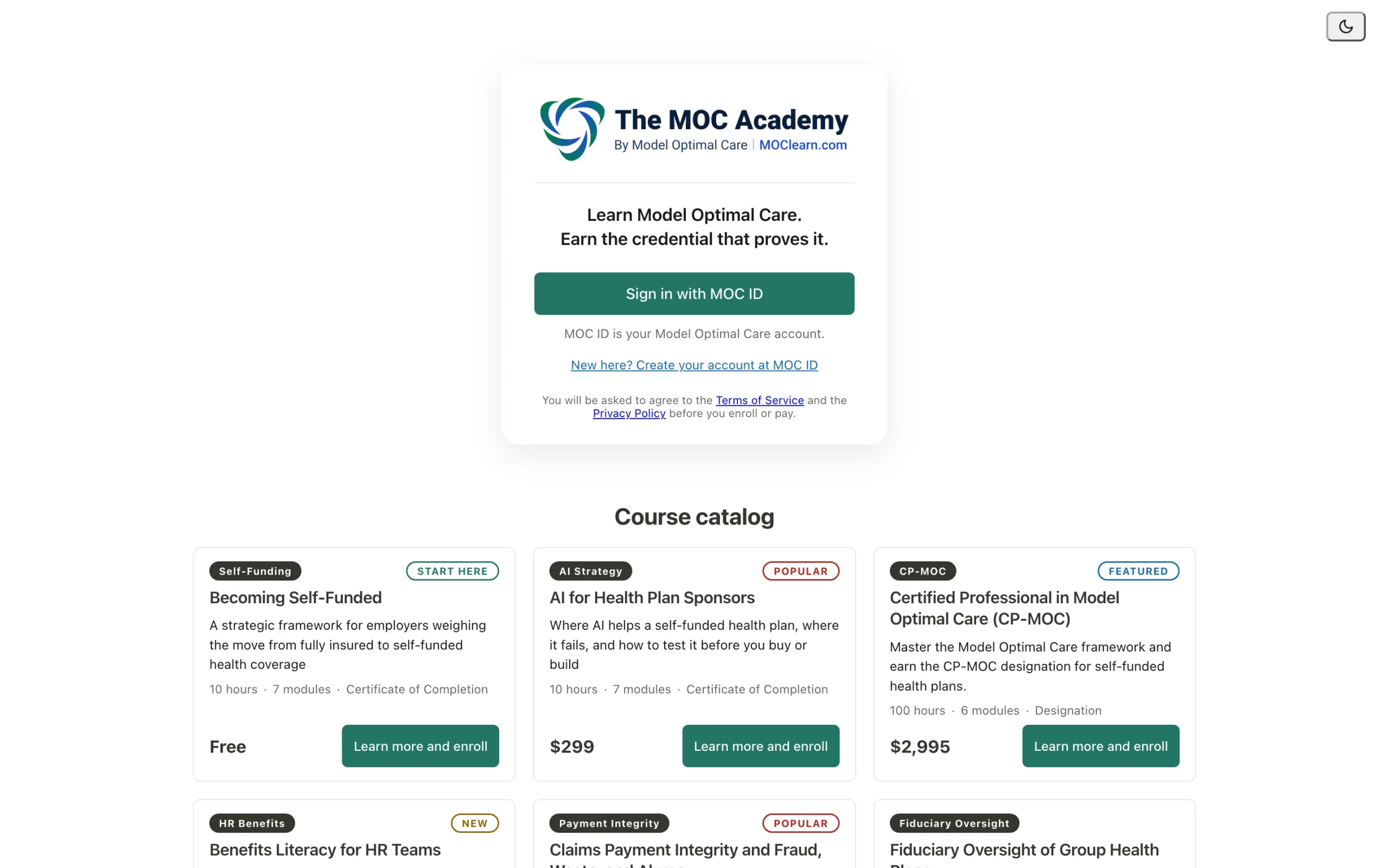
Course Catalog

The Model Optimal Care Academy offers a growing library of professional courses for healthcare benefits professionals. Each course is designed to deliver practical skills you can apply immediately after taking each course.

Foundational

Becoming Self-Insured: A Primer

A foundational course for organizations considering the transition from fully insured to self-funded health plans. Covers the economic drivers behind self-funding, the regulatory framework under ERISA, stop-loss coverage structures, vendor selection (TPA, ASO, PBM), plan design fundamentals, and a 15-week implementation timeline. Ideal for HR leaders, finance professionals, and benefits consultants advising mid-market employers.

Risk Management

Risk Modeling Fundamentals

Learn how to assess, quantify, and manage risk within self-insured health plans. Covers actuarial concepts in accessible terms, including specific and aggregate stop-loss thresholds, risk modeling, risk stratification, large claims probability modeling, and demographic risk adjustment. Build skills in evaluating plan exposure, setting clinical groupers and AI models, and communicating risk scenarios to executive stakeholders.

Analytics

Data Analytics Fundamentals

A practical introduction to healthcare data analytics for benefits professionals. Covers core concepts in claims data structure, key performance indicators for health plan evaluation, population health metrics, trend analysis, and benchmarking. Includes hands-on exercises in interpreting medical and pharmacy utilization reports. Designed for professionals who work with data daily but want a stronger analytical foundation.

Reporting

Report Building Fundamentals

Learn how to design, build, and present executive-level health plan reports that drive decision-making. Covers report design principles, data visualization best practices, narrative construction for different audiences (C-suite, benefits teams, employee communications), and dashboard layout. Includes templates and frameworks for large claims summaries, pharmacy savings analyses, ER utilization trends, and risk utilization dashboards.

Infrastructure

Data Warehousing for Health Plans

An introduction to data warehousing tailored for the self-insured health plan ecosystem. Covers data architecture fundamentals, ETL processes for medical and pharmacy claims, data integration across multiple sources (eligibility, labs, wellness, premiums), data quality and validation, and the role of a centralized data repository in supporting analytics, reporting, and AI-driven insights. Designed for technical professionals and benefits leaders.

More Courses Coming Soon

Join the newsletter to be notified when new courses are added to the catalog.