
By Jude Odu
August 19, 2026
Every conversation about self-funding starts in the same place. Are we big enough? It is the wrong first question, and it has been for a while. Sixty-seven percent of covered U.S. workers are already in self-funded plans, including 80 percent at firms with 200 or more workers. Among smaller employers, another 37 percent sit in level-funded arrangements. Size stopped being the gate some time ago.
Two things actually decide whether a transition works. Neither one appears in a broker’s pitch deck, because neither one is about whether you are ready to buy. They are about whether your plan can absorb a bad month, and whether you can see what you have been paying for.
Your Cash Position, Measured in Months
Self-funded plans do not fail on the annual number. They fail in the month when three catastrophic claims land together and the reserve is not there.
A fully insured premium is twelve identical payments you can budget to the dollar. A self-funded plan pays claims as they clear, which means the monthly number moves with utilization, with the calendar, and with whoever happened to have surgery in October. Model a typical 1,000-employee plan and something counterintuitive shows up. The self-funded version costs less over the year and more in seven of the twelve months. The cheap months are cheaper by more than the expensive months are dearer. A finance team that budgets on the annual figure and forgets the monthly one will meet a liquidity problem in a year that ends fine.
The test is specific. Take your expected annual claims and divide by twelve. For a 1,000-employee plan at roughly $18,500 per employee, expected claims run about $16.3 million, or $1.36 million a month. You want one to two months of that in an operating balance before go-live, so $1.4 million to $2.7 million, plus a committed line of credit sized to at least one more month. If you cannot fund a single month today, that is your answer. It is also a fixable one, and it is not a reason to keep paying a carrier to hold your money for you.
Your Claims History, in Detail
The second gate is whether you can see your own data. You need 24 to 36 months of detailed claims, and you need to run the distribution rather than the total.
The total tells you almost nothing. The distribution tells you where your risk actually sits, which members are driving it, and which of your high-cost claimants are ongoing versus resolved. That last distinction sets your stop-loss underwriting and your lasering exposure at renewal. Walk into a stop-loss negotiation without it and you get priced on the carrier’s assumptions instead of your own facts.
If your carrier hands you summary reporting and nothing else, you have found your gap. Close it before you do anything else, because the same data you need to qualify for self-funding is the data that makes self-funding worth doing.
The Other Six, Briefly
Six more dimensions matter, and all of them are softer. Risk tolerance, meaning whether budget certainty is a board requirement or a preference. Internal capacity, meaning whether anyone owns benefits as a job rather than as one duty among several. Advisory support, meaning whether your broker has a real self-funded book and discloses their compensation. Executive sponsorship, meaning whether your CFO is sponsoring this or merely interested. Population stability, meaning whether headcount swings more than 25 percent a year. And group size, which still matters below about 250 covered employees, where a single catastrophic claimant moves your year hard enough that you should buy a lower specific stop-loss deductible and treat aggregate coverage as required rather than optional.
None of those six will stop a transition on its own. Cash and claims will.
What You Are Actually Buying
Worth being straight about the number, because the market is not. The funding structure itself is worth roughly 3 percent of total plan cost, with a defensible range of 2 to 5 percent. For a 1,000-employee organization that is about $370,000 to $830,000 a year, available on day one, before you change a single benefit or renegotiate a single contract. Implementation runs $90,000 to $235,000 and pays for itself in four to eight months.
That is a good return. It is not the 20 to 40 percent that circulates in vendor decks, and you should be careful with anyone who quotes you a figure like that before looking at your claims.
The larger opportunity is the claims file itself. Payment integrity auditing, pharmacy contract renegotiation, site-of-care steerage, and high-cost claimant management all become possible once you own your own data. None of it happens automatically. Employers who self-fund and then do nothing with the data capture the structural savings and stop there.
If You Are Already Self-Funded
The question inverts. You are not asking whether you can bear the risk. You are asking whether you are extracting the value the structure makes available. Has anyone audited your claims in the last three years? Is your pharmacy contract genuinely pass-through? Have you ever exercised an audit right? Could you document your fee review if a participant asked?
That last question stopped being hypothetical this year. The Consolidated Appropriations Act of 2026 extended compensation disclosure to nearly every group health plan service provider, effective for any contract signed, extended, or renewed after February 3. In March, Stern v. JPMorgan Chase became the first of the major health plan fee cases to clear the standing bar in part, sending prohibited transaction claims into discovery.
What To Do This Quarter
Run the cash test first, because it takes an hour. Expected claims divided by twelve, multiplied by two, measured against what you could fund without a board conversation. Then call your carrier or administrator and ask for 24 to 36 months of detailed claims, not a summary. If they will not give it to you, you have learned something useful about your current arrangement.
Then look at the calendar. Fifteen weeks is achievable for a well-prepared employer with an executive sponsor and clean data already in hand. Published guidance for a first-time transition runs six months to two years. Whichever one describes you, the work starts with the same two questions, and both are about your organization rather than the market.
The market is not going to make this easier. Segal put 2027 medical trend at 9.9 percent, the steepest in roughly fifteen years, and family premiums rose 6 percent last year against 4 percent wage growth. The deductible increase that closed last year’s gap is creating this year’s access problem. Sooner or later the pressure moves from the employee side of the ledger back to the plan side, which is where the funding structure lives.
The full analysis is in our new white paper, Becoming Self-Funded: A Strategic Framework for Employer Health Plans, including the financial model behind these figures, the complete eight-dimension readiness assessment, a 15-week implementation framework, and the 2026 regulatory calendar. Download it here.
More about this topic can be explored in the book, Model Optimal Care: End U.S. Healthcare Waste, One Health Plan at a Time.
Stay Informed
Get The MOC Brief, the twice-weekly healthcare policy analysis for self-insured professionals and healthcare leaders committed to eliminating waste and optimizing care delivery.
About the author

Jude Odu
Founder of Health Cost IQ and author of Model Optimal Care. 25+ years in healthcare technology.
Learn more at judeodu.com
Categories
The Book
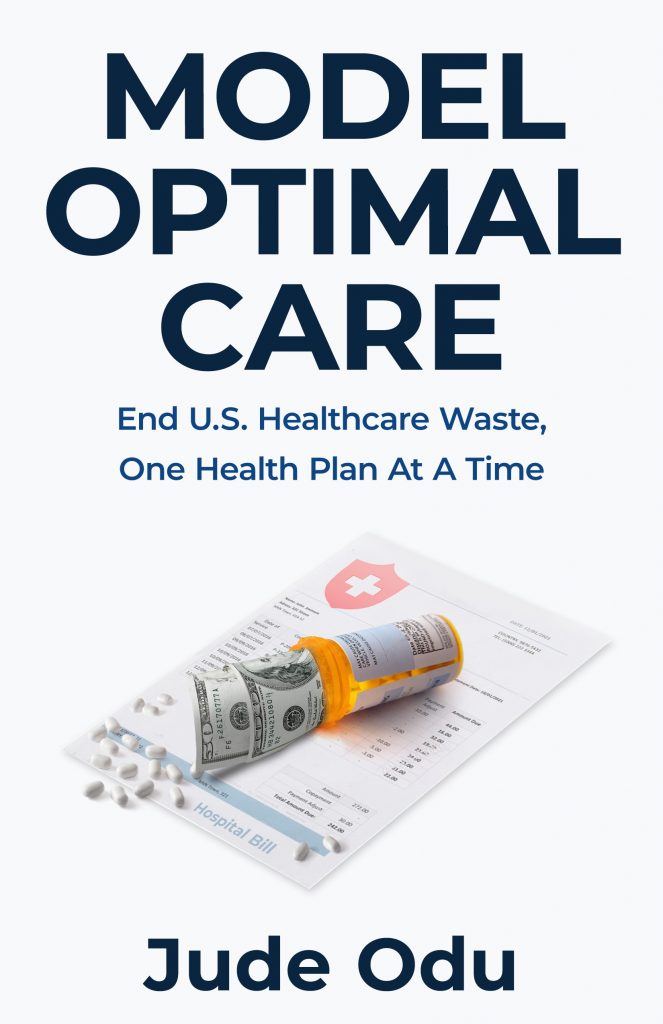
The definitive guide to ending U.S. healthcare waste. One health plan at a time.