
Cancer Is Your Plan’s Biggest Cost Driver. Here are Four Moves to Make Before Your Next Renewal.
By Jude Odu
July 13, 2026
For the fourth year in a row, cancer is the top condition driving cost in employer health plans. In Business Group on Health’s 2026 Employer Health Care Strategy Survey, 88% of the 121 large employers surveyed ranked cancer among their top three cost drivers. Musculoskeletal conditions came in at 71%, cardiovascular at 35%. Spending is climbing on top of that. The International Foundation of Employee Benefit Plans found that 86% of employers saw cancer care spend rise year over year, with a median increase of 11%.
You are working through renewal decisions right now. Most plan sponsors will likely respond the way they responded last year. Mercer’s national survey, fielded in April and May of 2026, found that 48% of large employers expect to make medical plan changes that raise employee out-of-pocket costs next year. The same survey puts the average cost of coverage above $18,500 per employee in 2026, a 6.7% increase.
Raising a deductible does not change what your plan pays for an oncology episode. It changes who writes the first check. The oncology bill stays exactly where it was.
Here is what to do instead.
Find out where the cancer dollars actually go
Cancer spend concentrates in three places: infused and specialty drugs, facility charges for infusion and surgery, and late-stage disease that earlier detection could have caught.
Site of care drives much of the facility number. A Health Affairs study of 2019 prices paid by Blue Cross Blue Shield plans found that hospital outpatient departments were paid 99% to 104% more than physician offices for infused cancer drugs, and 68% more for infused hormonal therapies. A 2025 matched cohort analysis in the Journal of Managed Care and Specialty Pharmacy found the same pattern across chronic conditions: higher outpatient costs in hospital settings, with no reduction in adverse events, inpatient admissions, or emergency visits. Same therapy. Same outcomes. Roughly double the price.
That difference is a billing decision made by a facility, and your plan pays it because nobody flagged it.
Recommended Action: Pull two years of paid claims and filter by members with an oncology diagnosis. Rank total spend by member. In most plans, a small number of cases drive the majority of cancer spend. Then split each case into drug, facility, professional, and imaging. You cannot manage a number you have never seen broken apart.
Benchmark oncology drug prices against public data
You have price benchmarks that did not exist two years ago.
The CY 2026 hospital price transparency rule took effect January 1, 2026, and CMS began enforcing it on April 1. Hospitals must replace the old estimated allowed amounts with actual figures drawn from 12 to 15 months of remittance data: the median, the 10th percentile, and the 90th percentile allowed amount, reported whenever a negotiated charge is based on a percentage or an algorithm. A CEO or designated senior official has to attest that the posted prices are true, accurate, and complete, with that person’s name encoded in the file.
A second reference point arrived January 1, 2026, when Medicare’s first ten negotiated Maximum Fair Prices took effect. Read this one carefully. Those prices apply to Medicare Part D, not to your plan, and only one of the ten drugs is an oncology therapy. Imbruvica came in at $9,319 for a 30-day supply against a $14,934 list price, a 38% discount. Across all ten drugs, discounts ran from 38% to 79% off 2023 list prices. Treat the number as a signal of what the federal government considered defensible, not necessarily as your ceiling.
Take your five largest oncology drug spends. Compare what your plan paid, net of rebates, against the published hospital allowed amounts in your market. If your pharmacy benefit manager cannot explain a large gap, you may have found real money that can be saved and a real fiduciary question to be answered.
Recommended Action: Ask your PBM, in writing, for the net cost per unit on your top oncology drugs, including all rebates, fees, and spread. Set a response deadline. Keep the reply in your fiduciary file.
Build a Center of Excellence path before you need it
About half of large employers will offer a cancer Center of Excellence in 2026, and another 23% are considering one by 2028, according to Business Group on Health.
A Center of Excellence does two things at once. It routes members to facilities with better outcomes on complex cancers, and it often carries a negotiated bundled rate that caps your exposure on the episode.
The cost case is direct. Segal’s 2026 medical stop-loss dataset, covering 225 health plans, puts the average stop-loss premium increase at 12.7% for groups that held their specific deductible steady, up from 9.7% the prior year. Segal also reports that the number of claimants with seven-figure claims has grown an average of 25% per year over the past four years. Sun Life’s 2026 high-cost claims report, built on more than 70,000 claims from over 3,300 self-funded employers, found million-dollar claims up 46% in frequency since 2022. Blood cancers produced the highest multimillion-dollar claims, averaging $5.45 million in 2025, with one leukemia case approaching $8 million.
Every high-cost cancer episode you route to a bundled case rate is an episode that does not blow through your specific deductible.
Recommended Action: Ask your third-party administrator which Centers of Excellence your network supports for oncology, what the travel benefit covers, and whether the arrangement is bundled or fee-for-service. A fee-for-service arrangement is a referral, not a cost control.
Treat screening as a cost strategy, not a wellness perk
Cancer diagnoses are rising in younger populations, and Business Group on Health has flagged early-onset cancer as a long-term concern that current screening guidelines were not designed to address. Employers are responding accordingly. In 2026, 49% of large employers will cover alternatives to colonoscopy, up from 41% in 2025. Coverage of all breast cancer screenings as preventive rises to 43%, up from 25%. Reduced or removed age limits on preventive screenings reach 29%, up from 12%.
The math supports the decision. Using SEER-Medicare data, researchers put cancer-attributable costs in the initial phase of care at $37,200 for stage I colorectal cancer and $113,889 for stage IV. That is roughly three times the cost for the same disease caught later, and commercial rates run higher than Medicare rates, so the gap inside your plan is likely wider. Screening is one of the few interventions where the clinical case and the financial case point the same direction.
Recommended Action: Check your preventive coverage against current guidelines, then check your actual screening rates in the claims data. Coverage on paper and utilization in practice are two different numbers. Close the gap with targeted outreach to the members who are eligible and have not gone.
Document every step
The ERISA litigation picture is more nuanced than the headlines suggest, and there’s a lesson to be learned in that nuance.
Courts dismissed the prescription drug fiduciary suits against Johnson & Johnson in November 2025 and against Wells Fargo in March 2026, both on standing grounds. Both are on appeal. Days later, in Stern v. JPMorgan Chase, the Southern District of New York took a different turn. The court dismissed the prudence and loyalty claims, holding that the choices at issue were plan design decisions, which are settlor functions rather than fiduciary acts. But it found standing based on out-of-pocket overpayments tied to PBM price markups, and it allowed a prohibited transaction claim involving the plan’s PBM to move forward.
Read that as a map. Design choices sit with the settlor. Vendor selection, contracting, and ongoing monitoring sit with the fiduciary, and that is where the exposure lives. The prudent person standard does not require you to get the lowest price on every claim. It requires a documented, reasoned process.
So, write it down. Record what you reviewed, what you asked your vendors, what they said, and what you decided. A benefits committee minute showing that you benchmarked oncology drug pricing and evaluated a Center of Excellence carries more weight than a spreadsheet nobody can explain.
Where to start this month
Cancer is not a line item you negotiate away at renewal. It is a category you manage through data, site of care, price benchmarking, and early detection. My book, Model Optimal Care: End U.S. Healthcare Waste, One Health Plan at a Time, builds this out through five principles: Transparency, Accountability, Integration, Engagement, and Technology Enablement. Cancer management touches all five.
Before your next benefits committee meeting, do one thing. Pull the oncology slice of your claims data and split it into drug, facility, professional, and imaging. Bring that single breakdown to the table. The conversation that follows will be more useful than any deductible discussion you’ve had in years.
Sources
Business Group on Health. 2026 Employer Health Care Strategy Survey, Executive Summary. August 2025. (Cancer top cost driver, fourth consecutive year; 88% top-three ranking; cancer COE at about half of employers in 2026 with 23% considering by 2028; screening coverage figures; median 9% trend.)
International Foundation of Employee Benefit Plans. “Cancer Care Spend Is on the Rise for U.S. Employers.” September 24, 2025. (86% of employers reported increased cancer care spend; median increase of 11%.)
Mercer. National Survey of Employer-Sponsored Health Plans, fielded April 15 to May 8, 2026. (48% of large employers expect plan changes raising out-of-pocket costs; average cost above $18,500 per employee; 6.7% increase.)
Robinson JC, Whaley CM, Brown TT. “Price Differences to Insurers for Infused Cancer Drugs in Hospital Outpatient Departments and Physician Offices.” Health Affairs 40, no. 9 (2021): 1395 to 1401.
Journal of Managed Care and Specialty Pharmacy. “Infusion therapy patient outcomes are similar at reduced costs in alternative sites of care compared with hospital outpatient departments.” 2025.
CMS. CY 2026 OPPS and ASC Final Rule: Hospital Price Transparency Policy Changes. November 2025. Requirements effective January 1, 2026; enforcement began April 1, 2026.
CMS. Medicare Drug Price Negotiation Program: Negotiated Prices for Initial Price Applicability Year 2026. Maximum Fair Prices effective January 1, 2026.
Segal. “Medical Stop-Loss Premiums Increase Nearly 13%.” 2026 national medical stop-loss dataset, 225 health plans. June 2026.
Sun Life U.S. High-Cost Claims and Injectable Drug Trends report. May 21, 2026.
Bradley CJ et al. “Cancer-Attributable Medical Costs for Colorectal Cancer Patients by Phases of Care.” JNCI Monographs, 2020. SEER-Medicare initial-phase costs by stage.
Stern v. JPMorgan Chase & Co., No. 1:25-cv-02097 (S.D.N.Y. Mar. 9, 2026); Lewandowski v. Johnson & Johnson (D.N.J. Nov. 26, 2025); Navarro v. Wells Fargo & Co. (D. Minn. Mar. 2026).
get Moc Insights
Get the latest healthcare policy analysis for self-insured professionals and healthcare leaders committed to eliminating waste and optimizing care delivery.
About the author

Jude Odu
Founder of Health Cost IQ and author of Model Optimal Care. 25+ years in healthcare technology.
Learn more at judeodu.com
Categories
The Book
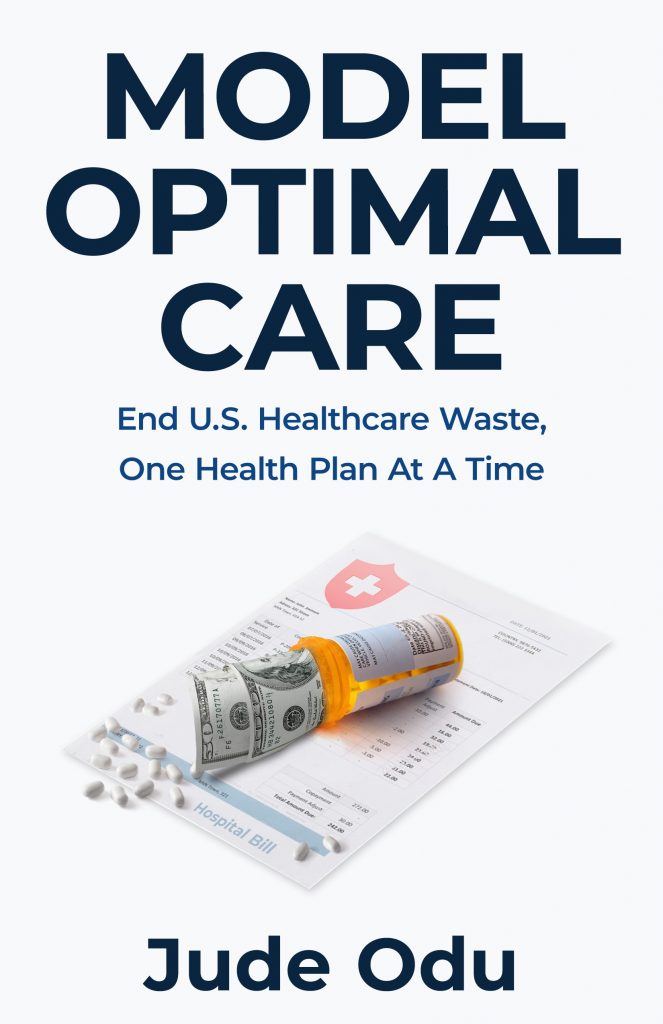
The definitive guide to ending U.S. healthcare waste. One health plan at a time.