
Insights on Healthcare Cost Containment, Fiduciary Strategy, and the Future of Employer-Sponsored Health Plans
By Jude Odu
May 5, 2026
This blog exists for one reason. Self-insured employers, brokers, third-party administrators, and benefits leaders are operating in the most consequential moment in the history of employer-sponsored healthcare. The decisions you make over the next twenty-four months will shape your health plan economics for the rest of the decade. I write here to give you the data, the legal context, and the practical strategies you need to act with confidence.
This first post sets the table. It pulls together the threads I have been working through in recent articles, interviews, and the chapters from my new book, Model Optimal Care: End U.S. Healthcare Waste, One Health Plan at a Time. Future posts will go deeper on each one.
The Numbers That Should Stop You Cold
The U.S. spends more than $5.6 trillion a year on healthcare. Between $760 billion and $1.6 trillion of that spending is waste, depending on which study you cite. That is roughly 25 to 30 cents of every healthcare dollar going to billing errors, administrative complexity, unnecessary services, pricing failures, and fraud.
Self-insured plans cover more than 160 million Americans. Roughly 67% of insured U.S. workers are already in self-funded arrangements, and adoption sits at about 95% among employers with 5,000 or more employees. The waste in those plans shows up as higher premiums, leaner benefits, and stagnant wages. My internal analyses across self-funded plans I have studied between 2014 and 2024 show that up to 50 cents of every claims dollar can be classified as wasteful or inefficiently spent.
That is the size of the problem. Now consider the size of the opportunity. Researchers have already quantified $191 billion to $282 billion in recoverable savings annually using interventions that already exist. The technology is built. The legal mandate is settled. The data is available. What is missing is execution.
Fiduciary Duty Is the New Frontier
For decades, plan sponsors have treated their health plans as a pass-through expense. That posture is no longer defensible. Under ERISA and the CAA of 2021, every self-insured employer carries explicit fiduciary obligations to spend plan assets prudently and exclusively in the interest of plan participants.
The litigation environment has caught up. In 2024 and 2025, Johnson & Johnson, Wells Fargo, JPMorgan Chase, and Mayo Clinic each faced lawsuits alleging fiduciary breaches tied to prescription drug pricing, excessive fees, and inadequate vendor oversight. A National Alliance of Healthcare Purchaser Coalitions survey found that 65 percent of employers expressed growing concern about fiduciary litigation exposure.
“The buck stops with the plan sponsor when it comes to fiduciary responsibilities involving health plan administration and operations.” — Christine Akers, SmartLight Analytics
You cannot delegate this responsibility to your TPA or ASO and assume compliance. You have to actively oversee claims payment accuracy, vendor compensation, and provider pricing. The math is unforgiving. Think about this: on a $50 million plan spend with a typical 14% payment inaccuracy rate, that is roughly $7 million a year flowing to vendor margins instead of employee benefits. That figure moves you beyond cost-management concerns and into fiduciary exposure.
Pricing Transparency Has Moved from Policy to Practice
CMS Hospital Price Transparency rules and the Transparency in Coverage requirements changed the underlying data environment for every self-insured plan. Hospitals must publish standard charges. Payers must publish negotiated rates. The 2024 enhancements added validation requirements and stiffer penalties for noncompliance. By 2026, plans operate in a market where the data exists.
The Purchaser Business Group on Health 2025 Data Demonstration Project marked the first time employers matched actual claims payments to transparent pricing data at scale. The findings confirmed what those of us in the field already knew. Negotiated rates for identical procedures can and do vary by more than 100% between regional markets. An echocardiogram can cost $350 at one facility and $2,700 at another in the same market with no measurable difference in quality.
“Under the Consolidated Appropriations Act of 2021, employers are legally accountable as fiduciaries for their health plans, requiring them to provide employees with the best healthcare benefits for the best price.” — Elizabeth Mitchell, President & CEO, Purchaser Business Group on Health
Translating this data into action is the work ahead. Machine-readable files become useful only after they are normalized, benchmarked, and matched against your own claims. That is where real cost reduction can be found.
PBM Reform Will Not Wait, and You Do Not Have to Wait for It
Pharmacy spend remains one of the largest and most opaque cost drivers in employer plans. The Federal Trade Commission 2024 interim staff report on prescription drug middlemen documented how the six largest PBMs manage roughly 95% of all U.S. prescriptions. Spread pricing, retained rebates, and contract terms that block plan-side audits keep those costs in the dark.
Three federal bills are now in motion. The PBM Reform Act of 2025 (H.R. 4317), the PBM Price Transparency and Accountability Act (S. 3345), and the Pharmacists Fight Back Act (H.R. 6609 and H.R. 6610) all target the same practices. Representative Earl L. Carter, who introduced the PBM Reform Act, said it is time to bust up the PBM monopoly. The American Medical Association has endorsed the bill, calling it a path toward long-overdue transparency, accountability, and fairness.
Here is my unequivocal message on PBMs. Fend for yourselves because help is likely not coming, and if it does, it may not come fast enough. Federal legislation may never pass. State-level action and CAA 2026 have filled some of the gap, with more than 30 PBM laws enacted across 20 states in 2024 alone. Even so, you should not condition your plan strategy on an act of Congress.
You can switch to a fiduciary PBM today. Organizations transitioning to transparent, pass-through pricing models are documenting savings of 15-30% on pharmacy spend in year one. That is real money returning to plan assets, paid for by closing a structural conflict of interest you never agreed to in the first place.
AI Moves the Intervention Point from After the Claim to Before the Check
Most of the conversation about AI in healthcare focuses on the front desk. Scheduling. Documentation. Ambient scribes. Those tools matter. They reduce administrative burden at the point of care. But they barely touch the financial problem lurking behind the scenes.
The real opportunity sits inside claims data. Every duplicate charge, every upcoded procedure, every facility fee added without clinical justification, every instance where a provider bills three to five times fair market rates appears there. Most employers never see it because their TPAs process hundreds of thousands of claims each year, and the typical audit reviews only 5 to 10% of those transactions.
AI changes the equation. A modern machine learning system can review 100% of claims in near real time, comparing every line item against established benchmarks, Medicare reference rates, and contract terms. Cotiviti, one of the largest healthcare analytics firms, identified roughly $15 billion in suspect claims across its client base in 2023 alone. The American Medical Association has documented a 20% claims-processing error rate among commercial insurers, equivalent to about $17 billion in annual waste. Industry analyses suggest up to 80% of hospital bills carry some form of inaccuracy.
“Now you have technology, machine learning, AI that can look at things, serve it up to the experts so they can actually make the decision. I think this will really change the trajectory of healthcare spend across the U.S.” — David Pierre, CEO, New Mountain Capital Payment Integrity Entity
Newer AI applications shift the intervention point earlier. Predictive models identify high-risk members months before a costly event would have appeared in claims data. Care managers can act on that signal. The model does not make the clinical decision. It flags the risk so a human can.
The Five Pillars of Model Optimal Care
Every article I write, every podcast I record, every consulting engagement I lead traces back to the same framework. Model Optimal Care is the next step beyond Value Based Care. It is more individualized, more methodical, more technology-enabled, more measurable, and more results-driven. Five core principles hold it together.
1. Transparency
You need full visibility into claims data, vendor contracts, pricing, and performance metrics. No optimization is possible without it. Reject any contract clause that limits your access to your own data.
2. Accountability
Every TPA, ASO, PBM, and broker should operate under measurable performance guarantees with consequences for missing them. Passive vendor management is the single largest source of unchallenged waste.
3. Integration
Medical claims, pharmacy claims, lab results, ancillary benefits, and wellness data have to live in one analytics environment. Siloed data produces fragmented insight and missed savings.
4. Engagement
Employees are stakeholders in the plan, not the audience for it. Give them education, comparison-shopping tools, and care navigation that fits how they actually use healthcare.
5. Technology Enablement
AI, predictive modeling, and real-time analytics turn a health plan from a fixed cost into a managed asset. Apply technology to anticipate risk and intervene before costs escalate. Violate any of these five principles and waste follows. Apply all five and your plan starts performing the way a modern, cost-efficient plan should.
A Practical Vision for the Self-Insured Community
The U.S. has roughly 23,000 organizations with 1,000 or more employees. If even a fraction adopted this approach, the cumulative savings would run into hundreds of billions of dollars. You do not have to fix the entire U.S. healthcare system. You only have to fix your slice of it. When enough organizations do, the ripple effect will reshape the U.S. economy.
Future posts on this blog will go deeper into specific topics. How to evaluate a fiduciary PBM. How to structure a payment integrity program that satisfies CAA requirements. How to use Medicare reference pricing without alienating your provider network. How to interpret transparency files in your local market. How to deploy AI in a plan that has never run advanced analytics before.
If you work in benefits, in risk management, in HR leadership, in third-party administration, in brokerage, or in consulting, you have more authority right now than you have ever had to reshape what health plans looks like. The data is on your side. The law is on your side. The technology is on your side.
The only remaining question is whether you act on it.
get Moc Insights
Stay ahead of the conversation on healthcare waste, cost containment, and the MOC framework.
About the author

Jude Odu
Founder of Health Cost IQ and author of Model Optimal Care. 25+ years in healthcare technology.
Full Bio →
Categories
The Book
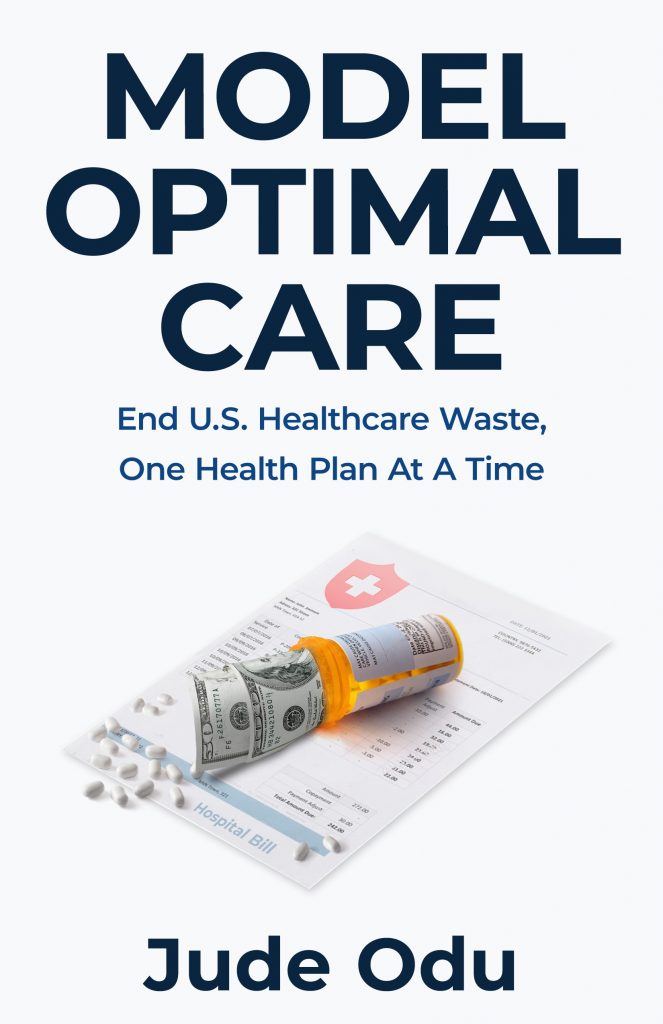
The definitive guide to ending U.S. healthcare waste. One health plan at a time.